
Physical precious metals can provide retirement investors with an alternative to holding all their savings in stocks, bonds and cash. However, not every gold coin, silver bar or collectible qualifies for a precious metals IRA.
To be eligible, bullion must satisfy specific requirements concerning its metal type, purity, production and storage. Buying the wrong product could create tax complications and leave you holding an asset that your IRA custodian will not accept.
This guide explains what IRA-approved bullion is, which coins and bars may qualify, what to avoid and how to add physical precious metals to a retirement account correctly.
Quick answer: IRA-approved bullion generally includes qualifying gold, silver, platinum and palladium coins, bars and rounds. Gold must typically be at least 99.5% pure, silver 99.9% pure, and platinum and palladium 99.95% pure. Certain coins—including American Gold Eagles—are specifically permitted even though they do not meet the usual gold fineness threshold.

What Is IRA-Approved Bullion?
IRA-approved bullion refers to physical precious metals that are eligible to be held inside an individual retirement account under Internal Revenue Code Section 408(m).
“IRA-approved” is a commonly used industry term. It does not mean that the IRS individually reviews or endorses every coin, bar, mint or precious metals dealer. Instead, a product must meet the requirements established by federal law and be accepted by the custodian administering the account.
Eligible bullion may include:
- Gold coins, bars and rounds
- Silver coins, bars and rounds
- Platinum coins and bars
- Palladium coins and bars
- Certain specifically authorized U.S. coins
- Qualifying products made by government mints or recognized refiners
The IRS generally treats metals and coins as collectibles. If an IRA acquires a nonqualifying collectible, the cost may be treated as a distribution from the account. Limited exceptions apply to certain coins and bullion that satisfy the relevant requirements. The IRS explains these collectible rules, while the underlying exemptions appear in Internal Revenue Code Section 408(m)(3).
IRA-Approved Bullion Requirements at a Glance
Most eligible precious metals must satisfy the following minimum purity levels:
| Precious metal | Minimum purity | Minimum fineness |
|---|---|---|
| Gold | 99.5% | .995 |
| Silver | 99.9% | .999 |
| Platinum | 99.95% | .9995 |
| Palladium | 99.95% | .9995 |
Purity alone does not automatically make a product IRA-eligible. The bullion must also meet applicable manufacturing, condition, custodial and storage requirements.
Many custodians require bars and rounds to come from a national government mint or an accredited refiner, assayer or manufacturer. The product ordinarily needs an identifiable mint or refiner mark, stated weight and stated purity.
Custodians may maintain their own approved-product policies. Therefore, investors should obtain confirmation from the custodian before purchasing any bullion for an IRA.
IRA-Approved Gold Bullion
Gold is the most widely recognized precious metal held in self-directed IRAs. Most eligible gold bullion must be at least 99.5% pure, although federal law provides an important exception for American Gold Eagle coins.
Popular IRA-Eligible Gold Coins
Commonly accepted gold coins include:
- American Gold Eagle bullion coins
- American Gold Eagle proof coins, subject to custodian requirements
- American Gold Buffalo coins
- Canadian Gold Maple Leaf coins
- Austrian Gold Philharmonic coins
- Australian Gold Kangaroo coins
- Australian Gold Lunar Series coins
- British Gold Britannia coins that meet the required purity
- Certain gold coins specifically permitted under federal law
Availability and acceptance can differ between custodians. Proof coins may also need to remain in their original packaging with an accompanying certificate of authenticity.
American Gold Eagle Purity Exception
The American Gold Eagle is made from 22-karat gold and is 91.67% pure. That would ordinarily place it below the 99.5% gold requirement.
Nevertheless, American Gold Eagles are specifically permitted by statute and can therefore qualify for an IRA. Their alloy contains small amounts of silver and copper for durability, but each coin contains the stated weight of pure gold.
This is an important reminder that purity is not the only eligibility test. Certain coins qualify because the law specifically identifies them.
IRA-Approved Gold Bars and Rounds
Qualifying gold bars and rounds generally must be at least .995 fine and produced by an acceptable government mint or recognized manufacturer.
Frequently encountered eligible producers include:
- The Royal Canadian Mint
- The Perth Mint
- PAMP Suisse
- Valcambi Suisse
- Credit Suisse
- Johnson Matthey
- Asahi Refining
- Royal Mint
- Argor-Heraeus
- Other recognized or accredited refiners
The presence of a well-known name does not guarantee that every product made by that company is eligible. The specific bar must still satisfy the purity, weight, condition and custodian requirements.
IRA-Approved Silver Bullion
Silver bullion must generally contain at least 99.9% pure silver. Because silver costs less per ounce than gold, investors can acquire more individual units, although that also means silver typically requires more storage space.
Popular IRA-Eligible Silver Coins
Examples commonly accepted for precious metals IRAs include:
- American Silver Eagle coins
- American Silver Eagle proof coins, subject to custodian rules
- Canadian Silver Maple Leaf coins
- Austrian Silver Philharmonic coins
- Australian Silver Kangaroo coins
- Australian Silver Kookaburra coins
- British Silver Britannia coins meeting the purity requirement
- Mexican Silver Libertad coins, when accepted by the custodian
- Certain other .999-fine sovereign bullion coins
IRA-Eligible Silver Bars and Rounds
Qualifying silver bars and rounds must usually be at least .999 fine and come from an acceptable mint, refiner or manufacturer.
Common sizes include:
- 1-ounce silver rounds
- 1-ounce silver bars
- 10-ounce silver bars
- Kilo silver bars
- 100-ounce silver bars
- Larger institutional bars that satisfy applicable specifications
Larger bars may carry lower premiums per ounce, but smaller units can provide more flexibility when an investor needs to sell only part of the account’s silver holdings.
IRA-Approved Platinum Bullion
Platinum bullion generally must be at least 99.95% pure. The selection is smaller than the gold and silver markets, but several recognizable products may qualify.
Examples include:
- American Platinum Eagle coins
- Canadian Platinum Maple Leaf coins
- Australian Platinum Kangaroo coins
- Certain platinum coins from recognized government mints
- .9995-fine platinum bars from accepted refiners
Platinum has extensive industrial uses, particularly in automotive, chemical and manufacturing applications. That can cause its price to respond differently from gold, but it can also introduce additional volatility.
IRA-Approved Palladium Bullion
Palladium must generally be at least 99.95% pure to qualify. It is less commonly held in retirement accounts and may have wider dealer spreads or fewer immediately available products.
Potentially eligible products include:
- American Palladium Eagle coins
- Canadian Palladium Maple Leaf coins
- Qualifying .9995-fine palladium bars
- Other approved products from recognized mints or refiners
Investors considering palladium should compare availability, premiums, storage costs and resale liquidity before making a decision.
Coins and Metals That Are Usually Not IRA-Eligible
Many valuable precious-metal products cannot be placed in an IRA. Common examples include:
- Rare or numismatic coins
- Pre-1933 U.S. gold coins
- South African Gold Krugerrands
- British Sovereigns
- French 20 Franc gold coins
- Swiss 20 Franc gold coins
- Austrian 100 Corona coins
- Collectible commemorative coins that do not qualify
- Jewelry
- Gold nuggets
- Sterling silver items
- Silverware
- Damaged or circulated bullion rejected by the custodian
- Bars that do not carry sufficient identification
- Products that fall below the minimum purity requirement
Some coins are excluded because they do not meet the required fineness. Others are treated primarily as collectibles rather than investment-grade bullion.
Before authorizing a purchase, ask the custodian to confirm the eligibility of the exact product—not simply the type of metal.
IRA-Approved Bullion vs. Collectible Coins
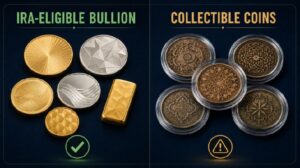
The difference between bullion and collectible coins is especially important inside a retirement account.
Bullion
Bullion derives most of its value from:
- Metal content
- Weight
- Purity
- Current precious-metals prices
- The premium charged above the spot price
Collectible coins
Collectible or numismatic coins may derive substantial value from:
- Rarity
- Age
- Historical importance
- Grade
- Condition
- Demand among collectors
Collectible coins can carry premiums far above their underlying metal value. Those premiums may be difficult to recover when the investor later sells.
For a retirement account, widely traded bullion may offer simpler pricing and easier comparisons. Investors should be cautious if a salesperson aggressively recommends expensive “exclusive,” “limited edition” or “semi-numismatic” coins without clearly disclosing their markup and expected resale value.
Does IRA Bullion Have to Be Stored in a Depository?
Qualifying bullion must be held in accordance with the custody requirements of Section 408. The statute provides for permitted bullion to be in the physical possession of a qualifying trustee.
In a conventional precious metals IRA arrangement, this means the metals are purchased through the account and delivered to a depository selected or approved by the custodian. The investor should not take personal possession while the assets remain inside the IRA.
Common storage options include:
Segregated storage
Your metals are identified and held separately from metals belonging to other customers.
Potential benefits include:
- Specific identification of holdings
- Clear inventory records
- Return of the same bars or coins, subject to the provider’s terms
Segregated storage may cost more than non-segregated storage.
Non-segregated or commingled storage
Your bullion is stored with metals of the same type belonging to other customers while ownership is recorded through the depository’s accounting system.
Potential benefits include:
- Typically lower storage fees
- Efficient handling
- Institutional inventory controls
Your distribution may consist of equivalent products rather than the exact units originally purchased, depending on the storage agreement.
Can You Store IRA-Approved Bullion at Home?
Buying qualifying bullion does not automatically make home storage permissible.
“Home storage Gold IRA” arrangements may expose an investor to prohibited-transaction, distribution and tax risks. The IRS could determine that the account owner exercised personal control over IRA assets instead of keeping them in the possession of a qualified trustee.
Personal possession may result in the metals being treated as distributed. Depending on the investor’s circumstances, that could lead to income taxes and potentially an additional early-distribution penalty.
Anyone considering a checkbook IRA, IRA-owned limited liability company or home-storage arrangement should obtain advice from an independent tax attorney or qualified tax professional—not rely solely on a metals salesperson.
How to Invest in IRA-Approved Bullion
Opening a precious metals IRA generally involves five main steps.
1. Choose a self-directed IRA custodian
Most conventional brokerage IRAs do not support direct ownership of physical bullion. Investors generally need a custodian that administers self-directed IRAs and permits precious metals.
Compare:
- Account setup fees
- Annual administration fees
- Transaction charges
- Wire and processing fees
- Supported depositories
- Online account access
- Distribution procedures
- Customer-service quality
- Experience with precious metals
The custodian administers the IRA but generally does not recommend whether gold is suitable for the investor.
2. Open the account
The investor completes an application for a traditional, Roth, SEP or SIMPLE IRA, depending on eligibility and retirement objectives.
Opening an account does not itself create a taxable event.
3. Fund the IRA
A precious metals IRA may be funded through:
- A trustee-to-trustee IRA transfer
- A direct rollover from an eligible employer plan
- A new annual IRA contribution
- An indirect rollover, although this involves additional deadlines and withholding risks
A direct transfer or direct rollover is generally simpler because the funds do not pass through the investor’s personal bank account.
The ability to move money from a current employer’s 401(k) depends on the plan’s rules. Former-employer plans are often more flexible, but investors should check with the plan administrator before starting.
4. Select qualifying bullion
After funding the account, the investor chooses eligible products through a precious metals dealer and authorizes the custodian to complete the transaction.
Before approving the order, request a written breakdown showing:
- Metal and product name
- Total quantity
- Price per unit
- Current spot price
- Dealer premium or markup
- Total purchase price
- Estimated liquidation value
- Shipping and handling costs
- Buyback terms, if offered
5. Send the metals to an approved depository
The dealer ships the bullion directly to the depository associated with the IRA. The custodian records the purchase, and the depository stores the assets for the benefit of the account.
The investor receives statements but should not personally receive or store the bullion while it remains inside the IRA.
Precious Metals IRA Transfer vs. Rollover
Although the terms are often used interchangeably, they describe different transactions.
| Feature | IRA transfer | Direct rollover |
|---|---|---|
| Typical source | Existing IRA | 401(k), 403(b), TSP or other employer plan |
| Movement of funds | Custodian to custodian | Plan administrator to new custodian |
| Investor handles money | No | Usually no |
| 60-day deadline | Generally no | Not for a properly completed direct rollover |
| Mandatory withholding | Generally no | Generally avoided when paid directly to the receiving custodian |
An indirect rollover pays the funds to the account owner, who must redeposit the eligible amount within the applicable deadline. Because errors can create taxes and penalties, many investors prefer a direct transfer or direct rollover when available.
How Much of a Retirement Portfolio Should Be in Bullion?
There is no universally correct allocation. An appropriate percentage depends on factors such as:
- Age and expected retirement date
- Total retirement savings
- Other investments
- Income requirements
- Risk tolerance
- Emergency reserves
- Views on inflation and financial markets
- Need for liquidity
- Estate-planning objectives
Physical bullion does not pay dividends or interest. Its value can rise or fall, and selling costs may be higher than those associated with publicly traded securities.
A concentrated allocation can create substantial risk. Investors should consider precious metals as one component of a broader retirement strategy and consult an independent fiduciary financial professional when appropriate.
Costs of Owning IRA-Approved Bullion
A precious metals IRA can involve more expenses than a standard brokerage IRA.
Possible costs include:
- One-time account setup fee
- Annual custodial or administration fee
- Depository storage fee
- Insurance-related charges
- Dealer premium above spot
- Transaction or wire fees
- Shipping and handling
- Liquidation spread when selling
- Account termination or distribution fees
Some providers charge flat annual fees, while others base fees on account value or the quantity of metals stored.
Promotional fee waivers can reduce short-term costs, but investors should examine the long-term fee schedule. A “free” account may still include product markups or wider buy-sell spreads.
Bullion Premiums and Dealer Spreads
The spot price is the current wholesale reference price for a precious metal. Retail investors ordinarily pay more than spot because the purchase price may include production, transportation, insurance and dealer compensation.
For example, if gold is trading at $3,000 per ounce and a one-ounce coin costs $3,210, the purchase premium is $210, or 7%.
The investor may also receive less than the retail selling price when liquidating. This difference is the dealer spread.
Questions to ask include:
- What percentage above spot am I paying?
- What would you pay to buy this product back today?
- Is the markup different for bars and coins?
- Are commissions included in the quoted price?
- Is the buyback policy guaranteed or merely offered when inventory is needed?
- How quickly are liquidation proceeds sent to the custodian?
A clear answer to these questions is more valuable than promotional claims about “exclusive” products.
Bullion Bars vs. Coins for an IRA
Both qualifying bars and coins may be appropriate, but they have different characteristics.
| Consideration | Bullion coins | Bullion bars |
|---|---|---|
| Recognition | Often highly recognizable | Depends on refiner |
| Premiums | Frequently higher | Often lower for larger bars |
| Partial liquidation | Convenient | Large bars can be less flexible |
| Storage efficiency | Moderate | Usually efficient |
| Counterfeit protection | Government security features may help | Assay cards and serial numbers may help |
| Product selection | Broad | Broad range of weights |
Investors prioritizing lower acquisition costs may favor common bars. Those prioritizing recognition and smaller incremental sales may prefer widely traded sovereign coins. A combination can provide flexibility.
Benefits of IRA-Approved Bullion
Potential advantages include:
Portfolio diversification
Gold and other metals do not always move in the same direction as stocks and bonds. That may help diversify a retirement portfolio, although diversification cannot prevent losses.
Ownership of tangible assets
A precious metals IRA holds physical bullion rather than merely shares in a company involved in mining or finance.
Potential inflation protection
Gold is often considered a long-term store of value. However, it does not reliably outperform inflation during every period.
Tax-advantaged account structure
Eligible transactions remain inside the IRA. Traditional and Roth accounts have different tax treatment, and ordinary IRA distribution rules still apply.
No dependence on one company’s performance
Physical bullion does not represent a claim on the profits or management of a corporation. Its price nevertheless remains subject to global market forces.
Risks and Disadvantages
Precious metals are not suitable for every retirement investor.
Important drawbacks include:
- Bullion does not produce income
- Prices can be volatile
- Dealers charge premiums and spreads
- Custodial and storage fees reduce returns
- Physical metals can take longer to liquidate than exchange-traded securities
- Some salespeople use high-pressure tactics
- Collectible or exclusive coins may carry substantial markups
- Required minimum distributions may require selling metals or distributing them in kind
- Excessive concentration can increase portfolio risk
- Tax or custody mistakes can disqualify a transaction
A reputable provider should explain these limitations clearly rather than presenting gold as guaranteed protection against every economic event.
How to Compare IRA Bullion Companies
Do not select a provider based on celebrity endorsements, fear-based advertising or a promotional offer alone.
Compare companies using the following criteria:
Transparent pricing
The company should disclose product prices, premiums or at least a complete written quote before the transaction is finalized.
Bullion-focused product selection
Look for widely traded, IRA-eligible products rather than an emphasis on high-premium collectible coins.
Reasonable minimum investment
Minimums vary considerably. A higher minimum may be appropriate for investors seeking specialized concierge support, but it should match the amount they reasonably want to allocate.
Independent custodian and depository
Understand which companies will administer and store the assets. The dealer, custodian and depository perform different roles.
Verifiable reputation
Review:
- Regulatory history
- Complaint patterns
- Length of operation
- Customer feedback across multiple platforms
- Responsiveness to complaints
- Lawsuits or enforcement actions
- Clarity of disclosures
A high average rating means little if the company suppresses criticism or has only a small number of reviews.
Written buyback procedures
No dealer can guarantee that metal prices will rise. A buyback program can simplify liquidation, but investors should determine how the repurchase price is calculated and whether the policy is contractually guaranteed.
Education without pressure
A trustworthy representative should give the investor time to compare prices, review documents and consult independent advisers.
Red Flags to Avoid
Be cautious when a salesperson:
- Guarantees profits or claims gold cannot decline
- Predicts an exact date for a market collapse
- Pressures you to transfer your entire retirement account
- Refuses to disclose the markup
- Avoids providing a written invoice
- Recommends mostly rare or exclusive coins
- Claims collectible coins cannot be confiscated
- Suggests storing IRA metals at home without explaining the tax risk
- Says the IRS has endorsed the company
- Promises an unrealistic buyback price
- Discourages you from speaking with a tax professional
- Uses “free metals” without explaining how the promotion affects pricing
Before signing, compare the proposed purchase price with the metal’s spot value and ask what the dealer would pay if you sold the same product immediately.
Frequently Asked Questions About IRA-Approved Bullion
What bullion is approved for an IRA?
Qualifying gold, silver, platinum and palladium coins, bars and rounds may be held in an IRA. Most must meet minimum fineness standards and come from an acceptable mint, refiner or manufacturer. The custodian must also agree to hold the specific product.
What is the purity requirement for IRA gold?
Gold generally must be at least 99.5% pure, or .995 fine. American Gold Eagles are a notable exception because federal law specifically permits them despite their lower percentage purity.
Is all 24-karat gold IRA-approved?
No. High purity alone does not guarantee eligibility. The product must also meet the relevant manufacturing, custody, condition and storage requirements.
Are gold Krugerrands IRA-approved?
South African Gold Krugerrands generally do not qualify because their 91.67% purity falls below the normal .995 gold standard and they do not receive the same statutory treatment as American Gold Eagles.
Are Canadian Maple Leafs IRA-approved?
Canadian Gold and Silver Maple Leaf coins generally meet the applicable purity standards and are commonly accepted, subject to confirmation by the IRA custodian.
Can rare coins be held in an IRA?
Most rare and collectible coins are not permitted. Even when a proof version of a bullion coin may qualify, investors should verify its eligibility and carefully evaluate its premium.
Can I use an existing IRA to buy bullion?
An existing IRA can often be transferred to a self-directed IRA custodian that supports physical precious metals. A custodian-to-custodian transfer generally avoids the investor taking possession of the funds.
Can I roll a 401(k) into a Gold IRA?
An eligible 401(k) may generally be rolled into a self-directed IRA. Access to money in a current employer’s plan depends on the plan’s distribution and in-service rollover rules.
Can I take possession of the bullion?
Not while maintaining it in a conventional precious metals IRA. The metals generally remain in the custody arrangement established through the IRA trustee or custodian. At an eligible distribution point, the investor may be able to take an in-kind distribution, which may be taxable depending on the account type and circumstances.
Does the IRS approve Gold IRA companies?
The IRS establishes tax rules but does not endorse particular Gold IRA dealers. Claims that a company is “IRS-approved” should be treated cautiously.
Are precious metals IRA losses guaranteed against?
No. Gold, silver, platinum and palladium can all lose value. Neither the government nor an ordinary depository insurance policy protects an investor against market-price declines.
Final Verdict: Is IRA-Approved Bullion Right for You?
IRA-approved bullion can give retirement investors direct exposure to physical gold, silver, platinum or palladium within a tax-advantaged account. It may help diversify a portfolio that is otherwise heavily dependent on conventional financial assets.
But successful precious-metals investing requires more than selecting a coin labeled “IRA eligible.” Investors must evaluate:
- Product eligibility
- Dealer markups
- Custodian fees
- Depository arrangements
- Liquidity
- Buyback spreads
- Tax rules
- Overall portfolio allocation
The safest approach is to compare several providers, insist on written pricing and confirm every proposed product with the IRA custodian before buying.
Get Your Free Gold IRA Guide
If you have retirement savings in an IRA, 401(k), 403(b) or TSP and are considering physical precious metals, request a free Gold IRA information guide before making a decision.
The guide can help you compare:
- IRA-approved gold and silver products
- Direct rollovers and IRA transfers
- Custodian and storage options
- Dealer fees and bullion markups
- Common rollover mistakes
- Questions to ask before selecting a Gold IRA company
Request Your Free Gold IRA Guide →
There is no obligation to open an account. Review the information, compare providers and decide whether physical precious metals fit your retirement strategy.
This article is for educational purposes and does not constitute investment, legal or tax advice. Precious metals can rise or fall in value. Consult qualified professionals before making retirement-account decisions.