
Imagine unlocking the ultimate control over your retirement. A 401k to Gold IRA rollover simply allows you to shift your savings—traditionally locked into standard mutual funds or company stock—into a powerhouse portfolio backed by physical gold, silver, platinum, or palladium. Best of all, when executed the right way, it’s a completely tax-free strategy that puts you firmly in the driver’s seat of your financial future. Let’s walk through how to set it up seamlessly.

Why Retirement Savers Are Rethinking the All-Paper 401(k)
A 401(k) is, by design, a container for stocks, bonds, and mutual funds. For most of your working life, that’s a reasonable structure. But several forces are pushing investors — particularly those within 5–15 years of retirement — to look at diversifying outside paper assets entirely:
- Inflation erosion. Even “moderate” inflation compounds. A dollar that buys less every year quietly shrinks a fixed-income-heavy portfolio’s real purchasing power.
- Sequence-of-returns risk. A market downturn in the years immediately before or after retirement can permanently impair a portfolio in a way the same downturn wouldn’t if it happened mid-career.
- Correlation concerns. Stocks and bonds have, at various points, moved together more than traditional 60/40 portfolio theory assumes — reducing the diversification benefit investors expect.
- Geopolitical and currency uncertainty. Tariff shifts, sovereign debt levels, and de-dollarization conversations among central banks have kept gold in the news as a reserve asset, not just a retail investment.
- A desire for a tangible asset. Some investors simply want to hold something with millennia of track record as a store of value, independent of any single company’s balance sheet or any government’s monetary policy.
Have an old 401(k) worth $50,000 or more?
Before moving any money, find out whether your account is eligible, what the rollover may cost, and which IRS rules apply. Request the free Gold IRA rollover guide for a no-obligation explanation of the process.
REQUEST YOUR FREE GOLD IRA GUIDE NOW ›
Step One: Take Inventory of Your Current 401(k)
Before initiating anything, answer three questions about your existing plan:
Are you still employed by the plan sponsor? Generally, the IRS and most plan documents prohibit rolling over an active 401(k) while you’re still working for that employer — unless your specific plan allows an in-service rollover (common after age 59½, sometimes earlier for non-matched contributions). If you’ve left the job, changed employers, retired, or were laid off, your old 401(k) is almost always rollover-eligible.
What type of 401(k) do you have? A traditional (pre-tax) 401(k) rolls cleanly into a traditional Gold IRA with no immediate tax event. A Roth 401(k) should roll into a Roth Gold IRA to preserve its tax-free treatment. Mixing the two incorrectly can create an unnecessary tax bill.
Does your plan hold employer stock with significant gains? If part of your 401(k) is in appreciated company stock, look into Net Unrealized Appreciation (NUA) treatment before rolling everything over. NUA can let you pay tax only on the stock’s original cost basis now, with the appreciation taxed later at (often lower) long-term capital gains rates — a benefit you forfeit once that stock moves into an IRA.
Are you near or over age 55 and recently separated from service? The Rule of 55 allows penalty-free 401(k) withdrawals if you leave that job in or after the year you turn 55. That protection disappears the moment those funds move into an IRA of any kind, including a Gold IRA — IRA withdrawals before 59½ generally trigger a 10% penalty regardless of why you left your job. If you might need access to funds between 55 and 59½, consider a partial rollover that leaves enough in the 401(k) to preserve that flexibility.
Direct Rollover: The Path Most Advisors Recommend
A direct rollover — also called a trustee-to-trustee transfer — moves funds straight from your 401(k) plan administrator to your new Gold IRA custodian. You never personally receive a check.
Why it’s preferred:
- No mandatory 20% federal tax withholding
- No 60-day deadline to worry about
- No risk of accidentally creating a taxable distribution through a missed deadline
- Generally the fastest, cleanest paper trail for IRS reporting purposes
The process in practice:
- Open your self-directed Gold IRA with a chosen custodian.
- Request rollover paperwork from your 401(k) plan administrator.
- Instruct the administrator to send funds directly to your new custodian (by check made payable to the custodian “for the benefit of” your account, or by wire).
- Your custodian deposits the funds and confirms receipt.
- You select and the custodian purchases IRS-approved metals, which ship to an approved depository.
Indirect Rollover: The Higher-Risk Alternative
In an indirect rollover, your 401(k) administrator sends the funds to you first, and you then have 60 days to deposit the full amount into your new Gold IRA.
The catch most investors don’t expect: Your 401(k) administrator is generally required to withhold 20% for federal taxes before sending you the check — even though you intend to roll the entire amount over. To complete a fully tax-free rollover, you must deposit the full original balance (including the withheld 20%) within 60 days, using other funds to cover the shortfall. You then recover the withheld amount when you file your tax return. Miss the 60-day window, or fail to replace the withheld portion, and the unrolled amount becomes a taxable distribution — plus a 10% early withdrawal penalty if you’re under 59½.
The one-rollover-per-year rule: The IRS limits IRA-to-IRA indirect rollovers to once every 12 months across all your IRAs. This limit does not apply to direct 401(k)-to-IRA rollovers, so executing a direct rollover into a Gold IRA doesn’t use up that annual allowance if you have other IRA moves planned.
Bottom line: unless you have a specific, well-understood reason to use an indirect rollover, the direct method removes an entire category of risk for no real downside.
Companies That Can Help With a 401k to Gold IRA Rollover
Navigating a 401k to gold IRA rollover requires a custodian you can trust with your future. Based on customer reviews, fee transparency, and buyback programs, here are the top three companies worth considering:
#1. Augusta Precious Metals — For In-Depth Education
Augusta Precious Metals is a strong option if you want time to understand a Gold IRA before making a decision. Its team offers educational resources and helps customers navigate the account setup and rollover process.
Augusta requires a minimum initial purchase of $50,000.
Visit Augusta Precious Metals>
#2. GoldenCrest Metals — For Personalized Guidance
GoldenCrest Metals emphasizes one-on-one service for people exploring a precious metals IRA. A specialist can help you understand the rollover steps and compare eligible gold and silver products.
GoldenCrest Metals requires a minimum initial purchase of $25,000.
#3. Goldco — For Rollover Resources
Goldco helps customers set up self-directed precious metals IRAs and offers guidance on funding an account through an eligible rollover. Its guides and videos can help you prepare questions about the process and available metals.
Goldco requires a minimum initial purchase of $25,000.
Choosing the Right Gold IRA Custodian
The IRS requires every self-directed IRA — Gold IRAs included — to be administered by a qualified custodian: a bank, trust company, or other entity specifically approved to hold IRA assets. The custodian is not the same as the precious metals dealer; they perform different jobs:
- The custodian handles IRS paperwork (Form 5498 for contributions, Form 1099-R for distributions), maintains records, and ensures the account stays compliant.
- The precious metals dealer sells you the actual coins or bars.
- The depository physically stores the metal.
What to evaluate in a custodian:
| Criterion | Why It Matters |
|---|---|
| Regulatory standing | Confirm they’re a bank, federally insured credit union, trust company, or IRS-approved nonbank trustee |
| Fee transparency | Get a written schedule for setup, annual administration, and any transaction fees |
| Depository relationships | Established custodians typically partner with recognized facilities like Delaware Depository, Brink’s, or International Depository Services |
| Reporting reliability | Ask how and when they issue your annual fair-market-value statements and tax forms |
| Responsiveness | A custodian you can actually reach matters more during a distribution or RMD than it seems at account opening |
Many Gold IRA companies work through the same handful of established custodians (such as Equity Trust Company or STRATA Trust Company), so you may end up choosing the metals dealer first and the custodian comes pre-paired.
The 401k to Gold IRA Rollover Process, Start to Finish
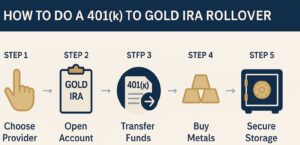
Here’s the realistic, full sequence — typically completed in 2 to 6 weeks, depending on how quickly your current plan administrator processes paperwork:
- Research and select a Gold IRA company and custodian that fits your account size and fee preferences.
- Open the self-directed IRA — usually a short application, often completed online or by phone in under 30 minutes.
- Initiate the rollover request with your 401(k) plan administrator, specifying a direct trustee-to-trustee transfer.
- Funds transfer from the 401(k) to the new IRA, either by check or wire. This step is usually the longest, taking anywhere from 5 business days to a few weeks depending on the administrator.
- Select your metals with guidance from your dealer, confirming each product meets IRS purity and sourcing standards.
- The custodian executes the purchase and arranges shipment directly to an IRS-approved depository — the metal never passes through your hands.
- Receive confirmation and account statements showing your holdings, storage location, and current fair market value.
Selecting and Acquiring IRS-Approved Precious Metals
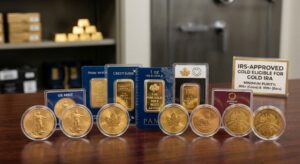
Not every gold product on the market qualifies for an IRA. The IRS treats most precious metals as “collectibles” under Internal Revenue Code Section 408(m) — which are normally prohibited in retirement accounts — with specific, narrow exceptions for investment-grade bullion.
Minimum Purity Standards
| Metal | Minimum Fineness | Common IRA-Eligible Products |
|---|---|---|
| Gold | 99.5% (.995) | American Gold Eagle (exception, see below), Canadian Gold Maple Leaf, Austrian Gold Philharmonic, Australian Gold Kangaroo, approved refiner bars |
| Silver | 99.9% (.999) | American Silver Eagle, Canadian Silver Maple Leaf |
| Platinum | 99.95% (.9995) | American Platinum Eagle, approved bars |
| Palladium | 99.95% (.9995) | Canadian Palladium Maple Leaf, approved bars |
The one notable exception: the American Gold Eagle is only 91.67% pure (22-karat) — yet Congress specifically wrote it into the tax code as IRA-eligible because it’s produced by the U.S. Mint and recognized as legal tender. No other sub-99.5% coin gets this treatment.
What’s Prohibited
- Rare or numismatic coins (value driven by rarity, not metal content)
- Graded/slabbed coins certified by services like PCGS or NGC, in most cases
- Gold jewelry, regardless of purity
- Gold rounds from private mints (not government-issued legal tender)
- Coins like the South African Krugerrand, which — despite being widely traded globally — does not carry the same statutory exception as the American Eagle
Placing a non-qualifying product into your IRA, even by mistake, can trigger a “deemed distribution” — the IRS treats the entire value as a taxable withdrawal, with a 10% penalty added if you’re under 59½.
Safekeeping: Where Your Gold Actually Lives
This is one of the most misunderstood parts of the entire process: you cannot legally store IRA-owned gold at home, in a personal safe, in a bank safe deposit box, or in a private LLC vault, regardless of what any “home storage IRA” promotion claims.
IRS rules require that IRA-held precious metals remain in the physical possession of a bank or an IRS-approved nonbank trustee — in practice, this means a specialized depository. Treating IRA gold as personally held property is functionally equivalent to taking a distribution, which can trigger immediate taxation and penalties.
Two storage structures to understand:
- Segregated storage — your specific coins or bars are stored separately, identified individually as yours. Costs more, but you hold a specific, traceable asset.
- Commingled (non-segregated) storage — your metals are stored alongside other investors’ like-kind holdings in a shared vault, with your ownership tracked by the custodian’s records. Typically less expensive.
Reputable depositories include facilities like Delaware Depository, Brink’s, and International Depository Services — all insured and independently audited.
What a 401k Rollover and Ongoing Ownership Actually Cost
Gold IRA fee structures differ meaningfully from a standard 401(k)’s expense ratio model. Expect these cost categories:
| Fee Type | Typical Range | Notes |
|---|---|---|
| Account setup fee | $50–$300 (one-time) | Sometimes waived for larger initial rollovers |
| Annual administration fee | $75–$300/year | Custodian’s cost for recordkeeping and compliance |
| Storage fee | $100–$300/year | Varies by segregated vs. commingled storage |
| Dealer premium (markup over spot) | 3–8% for standard bullion; higher for proof coins | This is where the bulk of “hidden” cost typically sits |
| Liquidation/buyback spread | Varies by company | Ask about this before funding the account |
| Wire transfer fees | $25–$50 (if applicable) | One-time, during funding |
A $50,000 account might run roughly $200–$500 per year in administrative and storage fees combined — a small percentage of assets, but worth comparing across companies since it compounds over a multi-decade holding period.
Tax Implications of Rolling a 401(k) Into a Gold IRA
This is the section to read most carefully, because getting it wrong is the single most expensive mistake in this entire process.
A properly executed rollover is not a taxable event. Whether direct or indirect, if completed correctly, you owe no income tax and no early withdrawal penalty at the time of the rollover — your money simply changes accounts while keeping its tax-advantaged status.
Where tax treatment diverges based on account type:
- Traditional 401(k) → Traditional Gold IRA: Tax-deferred growth continues. You’ll owe ordinary income tax on distributions in retirement, just as you would have from the original 401(k).
- Roth 401(k) → Roth Gold IRA: Growth and qualified withdrawals remain tax-free, provided the account meets the standard Roth holding-period and age requirements.
- Traditional 401(k) → Roth Gold IRA (a Roth conversion): This is a taxable event. You’ll owe ordinary income tax on the converted amount in the year of conversion — sometimes a deliberate strategy, but never something to do accidentally.
Required Minimum Distributions (RMDs): Traditional Gold IRAs are subject to RMDs starting at age 73, the same as any traditional IRA. Because gold doesn’t generate cash flow the way dividends or bond interest do, you’ll need to either liquidate a portion of your metals to generate cash for the RMD or take an in-kind distribution of physical metal (which is then taxed at its fair market value).
2026 contribution limits, for context (these don’t apply to rollover amounts): the standard IRA contribution limit is $7,500, rising to $8,600 for those 50 and older. Workers aged 60–63 may be eligible for an even higher “super catch-up” limit in their 401(k) under SECURE 2.0 provisions. None of these caps restrict how much you can move via rollover — only new annual cash contributions.
⚠️ The mistake that costs people the most. Taking personal possession of distributed metals, even briefly, before they reach an approved depository can be treated by the IRS as a taxable distribution of the full account value. Always have funds and metals move custodian-to-custodian and dealer-to-depository — never through your personal hands or bank account in the case of metals.
Pros and Cons of a 401k to Gold IRA Rollover
| Pros | Cons |
|---|---|
| Diversification away from paper assets (stocks, bonds, currency-denominated holdings) | Gold produces no dividends, interest, or cash flow |
| Historical role as an inflation and currency-debasement hedge | Storage, custodian, and dealer fees add ongoing cost not present in many 401(k)s |
| Tax-deferred or tax-free growth, same as any IRA | Less liquid than selling a stock — selling requires going through the custodian and dealer |
| Tangible asset not tied to any single company’s solvency | Dealer premiums and spreads can meaningfully affect near-term returns |
| Full control over asset allocation in a self-directed structure | More complex to administer than a standard brokerage IRA |
| Protection from certain custodial/counterparty risks tied to paper assets | Funds in an IRA lose 401(k)-specific protections, like the Rule of 55 |
Who Should Consider a 401k to Gold IRA Rollover?
A 401k to Gold IRA rollover tends to make the most sense for investors who:
- Have a sizable old 401(k) from a former employer sitting in default investments they haven’t reviewed in years
- Are within roughly 5–15 years of retirement and want to reduce portfolio volatility through diversification, not eliminate it
- Already hold a diversified stock/bond portfolio and want to allocate a modest portion (many financial professionals suggest somewhere in the 5–15% range, though this depends entirely on individual circumstances) to physical metals
- Have genuine concerns about currency debasement, geopolitical risk, or counterparty risk in the financial system, and want an asset outside that system
- Don’t need the rolled-over funds for near-term liquidity, given the friction involved in selling physical metal compared to a stock trade
It tends to make less sense for investors who:
- Are still working for the employer sponsoring the 401(k) and don’t have in-service rollover access
- Are between 55 and 59½, recently separated from service, and might need penalty-free access to funds under the Rule of 55
- Have a relatively small account where minimums and fixed annual fees would consume a disproportionate share of the balance
- Are looking for growth and income, not stability — gold’s historical role is wealth preservation, not the highest expected return
Which 401(k) Accounts Are Eligible for This Rollover?
- Traditional 401(k) from a former employer — generally eligible at any time after separation.
- Roth 401(k) from a former employer — eligible, and should roll into a Roth Gold IRA to preserve tax treatment.
- 401(k) from a current employer — generally not eligible unless the plan specifically allows in-service rollovers, often available after age 59½.
- 403(b) and 457(b) plans — typically follow similar rollover rules to a 401(k) and can usually roll into a self-directed Gold IRA under the same direct-transfer process.
- Thrift Savings Plan (TSP) — federal employees can generally roll over a TSP into a Gold IRA after separation from federal service, following the TSP’s own transfer procedures.
- Orphaned small-balance 401(k)s — accounts below certain thresholds may be subject to automatic rollover into a default IRA (often a low-yield money market fund) if left unaddressed after you leave a job. Consolidating these into a self-directed account you actually chose is usually preferable to letting that happen by default.
401k to Gold IRA rollover Conclusion: Make the Decision Deliberately, Not Reactively
A 401k to Gold IRA rollover is neither a guaranteed safeguard nor a gimmick — it’s a structural decision about how much of your retirement savings you want exposed to paper assets versus a tangible, historically non-correlated one. The mechanics are well-established and, when followed correctly through a direct trustee-to-trustee transfer, carry no tax consequence at the time of the move.
What separates a good outcome from a costly mistake isn’t luck — it’s process. Confirm your 401(k) is actually eligible. Choose a custodian and dealer with transparent, written fee structures. Buy only IRS-approved metals. Let the metals go straight to an approved depository. And size the allocation as a deliberate piece of a broader retirement strategy, not an all-or-nothing bet.
If gold’s role as an inflation hedge and portfolio diversifier appeals to you, the next responsible step isn’t to fund an account today — it’s to get the specifics in writing and ask the questions this guide has equipped you to ask.
📞 Ready to Explore Your Options?
Request your free Gold IRA rollover guide for a no-obligation breakdown of fees, eligible metals, and the exact paperwork your situation requires.
REQUEST YOUR FREE GOLD IRA GUIDE NOW ›
Frequently Asked Questions
Is a 401(k) to Gold IRA rollover taxable?
No, not if it’s done correctly. A direct trustee-to-trustee rollover, or a properly completed indirect rollover within the 60-day window, is not a taxable event. The funds retain their tax-advantaged status; you simply move from one qualified retirement structure to another.
Can I roll over a 401(k) from my current employer?
Generally, no — unless your specific plan document permits an in-service rollover, which is more common after age 59½. 401(k)s from former employers are almost always eligible for rollover regardless of your age.
How long does a 401(k) to Gold IRA rollover take?
Typically 2 to 6 weeks from start to finish, with most of that time spent waiting on your former plan administrator to process and release the funds. The custodian and depository steps on the back end are usually faster.
Can I store my Gold IRA metals at home?
No. IRS rules require precious metals held in an IRA to be stored at an approved depository in the custody of a bank or IRS-approved nonbank trustee. Personal possession — including home safes or personal safe deposit boxes — is treated as a distribution and can trigger taxes and penalties.
What happens if I take the indirect rollover route and miss the 60-day deadline?
The amount not redeposited within 60 days becomes a taxable distribution. If you’re under 59½, it also typically triggers a 10% early withdrawal penalty, on top of ordinary income tax on the distributed amount.
Does rolling over my 401(k) affect the Rule of 55?
Yes. The Rule of 55 (penalty-free 401(k) withdrawals if you separate from service at 55 or later) applies specifically to the 401(k), not to IRAs. Once funds move into a Gold IRA, standard IRA early-withdrawal rules apply, generally requiring you to wait until 59½ for penalty-free access.
What’s the minimum amount needed to open a Gold IRA?
It varies significantly by company — from roughly $10,000 at some firms to $50,000 at others. Always confirm current minimums directly with the company, as they can change.
Can I roll over only part of my 401k into a Gold IRA?
Yes, in most cases. A partial rollover lets you diversify into precious metals while keeping a portion of your funds in your original 401(k) or moving it to a traditional IRA — useful if you want to preserve specific protections (like the Rule of 55) or maintain liquidity.
Related Articles
- How to Invest $10 Million for retirement
- Top 5 Gold IRA Companies
- GoldenCrest Metals Review
- Protect Your Future with Gold and Silver
- Advantage Gold Review
- Noble Gold Review
This article is for informational purposes only and does not constitute tax, legal, or investment advice. Precious metals investing involves risk, including price volatility. Consult a qualified tax professional or financial advisor about your specific situation before initiating a rollover.