
If you’re a federal employee or military service member approaching retirement, you’ve likely asked yourself an important question:
“Can I move my TSP into a Gold IRA?”
The short answer is yes—provided you meet the IRS eligibility requirements and follow the proper rollover process.
With inflation continuing to erode purchasing power, persistent market volatility, and growing concerns about national debt and economic uncertainty, many retirees are looking beyond traditional paper assets. Physical gold has become an increasingly popular way to diversify retirement savings and potentially reduce portfolio risk over the long term.
A Gold IRA allows eligible investors to own IRS-approved physical gold, silver, platinum, and palladium within a tax-advantaged retirement account. For former federal employees and retirees, rolling over part or all of an eligible Thrift Savings Plan (TSP) balance into a self-directed Gold IRA can provide broader investment choices than the standard TSP fund lineup.
However, completing a TSP to Gold IRA rollover involves important IRS rules. A mistake could trigger unnecessary taxes or early withdrawal penalties, making it essential to understand the process before taking action.
In this comprehensive guide, you’ll learn:
- What a TSP to Gold IRA rollover is
- Who qualifies for a rollover
- How the rollover process works
- Direct vs. indirect rollovers
- Traditional and Roth TSP rollover rules
- IRS regulations you must follow
- Potential advantages and disadvantages
- Common mistakes to avoid
- How to choose a reputable Gold IRA company
By the end of this guide, you’ll have a clear understanding of whether moving part of your retirement savings into physical precious metals aligns with your financial goals.
Free Gold IRA Guide
Considering a TSP rollover? Before making any decisions, request a FREE Gold IRA Guide to learn how self-directed Gold IRAs work, understand IRS regulations, compare rollover options, and avoid costly mistakes. There is no obligation, and it can help you make a more informed retirement planning decision.
Quick Answer
Yes, you can roll over an eligible Traditional TSP or Roth TSP into a self-directed Gold IRA without paying taxes or penalties if the rollover is completed according to IRS rules.
In most cases, the safest method is a direct trustee-to-trustee rollover, where funds move directly from your TSP account to your new IRA custodian. This approach minimizes the risk of taxes, withholding, or missed deadlines.
Once the rollover is complete, your self-directed IRA custodian can purchase IRS-approved precious metals on behalf of your retirement account. These assets are then stored in an approved depository, as required by IRS regulations.
Many retirees choose to roll over only a portion of their TSP rather than their entire balance, allowing them to maintain exposure to traditional investments while adding physical precious metals as a diversification strategy.
Table of Contents
- What Is the Thrift Savings Plan (TSP)?
- Why More Federal Employees Are Considering Gold
- Can You Roll a TSP Into a Gold IRA?
- How a TSP to Gold IRA Rollover Works
- Direct vs. Indirect TSP Rollovers
- Traditional TSP vs. Roth TSP Rules
- Who Qualifies?
- Benefits of Moving Part of Your TSP Into Gold
- Potential Risks
- IRS Rules You Must Follow
- Eligible Gold Coins and Bars
- Step-by-Step TSP to Gold IRA Rollover Process
- Timeline
- Costs and Fees
- Tax Consequences
- TSP Funds That Cannot Be Rolled Over
- Should You Roll Over All or Only Part?
- Gold IRA vs. Keeping Money in TSP
- How to Choose a Gold IRA Company
- Frequently Asked Questions
What Is the Thrift Savings Plan (TSP)?
The Thrift Savings Plan (TSP) is a tax-advantaged retirement savings program designed for:
- Federal civilian employees
- Members of the U.S. Armed Forces
- National Guard personnel
- Reserve members
- Certain other federal workers
It functions similarly to a private-sector 401(k) plan, allowing participants to contribute a portion of their salary toward retirement while benefiting from tax advantages and, in many cases, employer matching contributions.
As one of the largest defined contribution retirement plans in the world, the TSP offers participants access to a limited but diversified menu of investment funds.
The Main TSP Investment Funds
The TSP currently offers several core investment options:
| Fund | Investment Focus | Risk Level |
|---|---|---|
| G Fund | Government Securities | Very Low |
| F Fund | Bonds | Low |
| C Fund | Large U.S. Stocks | Moderate |
| S Fund | Small & Mid-Cap Stocks | High |
| I Fund | International Stocks | High |
| Lifecycle (L) Funds | Professionally Allocated Mix | Varies |
These funds are designed to help participants build retirement savings through diversified exposure to stocks and bonds.
However, one notable limitation is that the TSP does not allow participants to purchase physical gold or silver directly.
Investors seeking exposure to tangible precious metals typically need to transfer eligible retirement assets into a self-directed Gold IRA, which offers a wider range of permissible investments.
Why Some Investors Look Beyond the TSP
The TSP is widely regarded as a low-cost retirement plan, but some investors seek additional flexibility for reasons such as:
- Greater control over investment choices
- Access to alternative assets
- Portfolio diversification
- Inflation concerns
- Long-term wealth preservation
- Reduced reliance on stock and bond markets
A self-directed Gold IRA can complement—not necessarily replace—a traditional retirement portfolio by allowing ownership of IRS-approved physical precious metals.
Why More Federal Employees Are Considering Gold
Retirement planning has become increasingly complex in recent years. While equities have historically delivered long-term growth, periods of market volatility can significantly affect retirement account balances, especially for individuals nearing retirement who have less time to recover from market downturns.
As a result, some federal employees are exploring physical gold as part of a diversified retirement strategy.
1. Inflation Can Reduce Purchasing Power
Inflation gradually increases the cost of goods and services, reducing what your retirement savings can buy over time.
Although no investment is immune to economic conditions, some investors view physical gold as a potential store of value during periods of elevated inflation.
Rather than replacing traditional investments, gold is often used to diversify a portfolio that may otherwise be heavily concentrated in stocks and bonds.
2. Stock Market Volatility
Market corrections are a normal part of investing, but they can be stressful for retirees who depend on their portfolios for income.
Unlike stocks, physical gold is not tied to the earnings of individual companies. Some investors include it in their retirement portfolios to help diversify overall risk.
Diversification does not guarantee profits or prevent losses, but it may help reduce the impact of any single asset class underperforming.
3. Diversification Beyond Traditional Assets
Many TSP participants hold retirement savings primarily in stock and bond funds.
A Gold IRA provides exposure to a different asset class—physical precious metals—that may behave differently from financial markets under certain economic conditions.
This broader diversification is one reason some retirees choose to allocate a portion, rather than all, of their retirement assets to gold.
4. Long-Term Wealth Preservation
Gold has been valued for centuries because of its scarcity, durability, and widespread recognition.
While its price can fluctuate over shorter periods, many investors consider physical gold a long-term component of a diversified retirement strategy rather than a vehicle for short-term speculation.
5. Greater Investment Flexibility
The TSP offers a carefully selected range of investment funds, but it does not permit direct ownership of physical precious metals.
A self-directed Gold IRA expands the range of eligible investments, allowing qualified investors to own IRS-approved gold, silver, platinum, and palladium within a tax-advantaged retirement account.
For investors seeking broader diversification, this additional flexibility can be appealing.
Can You Roll a TSP Into a Gold IRA?
Yes—but eligibility depends on your employment status and the type of withdrawal or distribution permitted under TSP and IRS rules.
Generally, You May Be Eligible If You:
- Have separated from federal service.
- Are retired.
- Have an eligible TSP distribution.
- Meet IRS rollover requirements.
If you’re still actively employed, your rollover options may be more limited. Some participants may qualify for age-based in-service withdrawals under certain conditions, while others may need to wait until they separate from service before moving TSP assets to an IRA.
Because individual circumstances vary, it’s important to review the applicable TSP and IRS rules or consult a qualified tax or financial professional before initiating a rollover.
Can You Own Physical Gold Inside a TSP?
No.
The Thrift Savings Plan does not permit participants to purchase or store physical gold bullion, gold bars, or gold coins directly within the plan.
To own physical precious metals in a tax-advantaged retirement account, eligible participants typically need to roll over qualifying TSP funds into a self-directed Gold IRA administered by an approved custodian.
Can You Roll Over Only Part of Your TSP?
Yes.
Many investors choose a partial rollover, transferring only a portion of their retirement savings into a Gold IRA while leaving the remainder invested in the TSP.
This approach can allow retirees to maintain exposure to the TSP’s low-cost investment funds while adding physical precious metals as part of a diversified retirement strategy.
The appropriate allocation depends on your financial goals, risk tolerance, investment time horizon, and overall retirement plan.
How a TSP to Gold IRA Rollover Works
A TSP to Gold IRA rollover is the process of transferring eligible retirement funds from your Thrift Savings Plan into a self-directed Individual Retirement Account that permits investments in IRS-approved precious metals.
Unlike a taxable withdrawal, a properly executed rollover preserves the tax-advantaged status of your retirement savings.
The Typical Process
Step 1: Choose a reputable self-directed Gold IRA custodian.
Step 2: Open your new Gold IRA account.
Step 3: Request a direct rollover from your TSP administrator.
Step 4: Funds are transferred directly to your new IRA custodian.
Step 5: Select IRS-approved precious metals for purchase within the IRA.
Step 6: The metals are shipped to an approved secure depository, where they remain on behalf of your IRA.
The key advantage of a direct rollover is that you never take possession of the funds, reducing the likelihood of triggering taxes or penalties due to administrative errors.
Direct vs. Indirect TSP Rollovers

Once you’ve decided to move eligible retirement funds into a Gold IRA, the next step is choosing how the rollover will be completed.
Although both direct and indirect rollovers can transfer retirement assets, they differ significantly in terms of simplicity, tax treatment, and the risk of costly mistakes. Understanding these differences is essential before initiating your rollover.
What Is a Direct TSP to Gold IRA Rollover?
A direct rollover—also called a trustee-to-trustee transfer—is the method most financial professionals recommend.
With a direct rollover:
- You open a self-directed Gold IRA with an IRS-approved custodian.
- You authorize the transfer of eligible TSP assets.
- Your TSP administrator sends the funds directly to your new IRA custodian.
- The custodian deposits the funds into your Gold IRA.
- You select IRS-approved precious metals, which are purchased and stored in an approved depository.
At no point do you personally receive the money.
Advantages of a Direct Rollover
- No mandatory tax withholding
- No 60-day rollover deadline to worry about
- Lower chance of administrative errors
- Preserves your retirement account’s tax-advantaged status
- Generally the simplest rollover method
For these reasons, most investors choose a direct rollover whenever possible.
What Is an Indirect Rollover?
An indirect rollover works differently.
Instead of sending funds directly to your IRA custodian, the TSP distributes the money to you first. You must then deposit the full eligible amount into your new IRA within 60 days to maintain tax-deferred treatment.
If you fail to complete the rollover within the required timeframe, the IRS may treat the distribution as taxable income. If you’re under age 59½, an additional early withdrawal penalty may also apply unless an exception is available.
Another consideration is that certain distributions may be subject to mandatory federal tax withholding, requiring you to replace the withheld amount from other funds if you wish to complete a full tax-free rollover.
Potential Drawbacks of an Indirect Rollover
- Strict 60-day deadline
- Greater risk of taxes and penalties if mistakes occur
- More paperwork and administrative complexity
- Possible mandatory tax withholding on eligible distributions
Unless there is a specific reason to use an indirect rollover, many investors prefer the direct method because it minimizes these risks.
Direct vs. Indirect Rollover Comparison
| Feature | Direct Rollover | Indirect Rollover |
|---|---|---|
| Funds sent directly to custodian | ✅ Yes | ❌ No |
| You receive the money | ❌ No | ✅ Yes |
| Mandatory withholding | Typically No | May apply |
| 60-day deadline | No | Yes |
| Lower risk of taxes | ✅ Yes | ❌ No |
| Simpler process | ✅ Yes | ❌ More complex |
Thinking About a Gold IRA?
Before choosing a rollover method, request your FREE Gold IRA Guide. It explains the rollover process, IRS rules, eligible precious metals, and questions to ask before opening an account.
Traditional TSP vs. Roth TSP Rules
The tax treatment of your rollover depends on whether your retirement savings are held in a Traditional TSP or a Roth TSP.
Traditional TSP
Traditional TSP contributions are generally made with pre-tax dollars.
If you roll eligible Traditional TSP assets into a Traditional Self-Directed Gold IRA, the transaction is generally tax-deferred, provided all applicable IRS rules are followed.
Taxes are typically deferred until qualified withdrawals are taken during retirement.
Roth TSP
Roth TSP contributions are made using after-tax dollars.
Eligible Roth TSP assets are generally rolled into a Roth Self-Directed Gold IRA to preserve their tax treatment.
Qualified withdrawals from a Roth IRA may be tax-free if IRS requirements are met.
Mixing Traditional and Roth Funds
Traditional and Roth retirement assets are generally maintained separately because they receive different tax treatment.
A qualified Gold IRA custodian can explain how these funds are handled during the rollover process.
Who Qualifies for a TSP to Gold IRA Rollover?
Eligibility depends on your employment status and the type of TSP distribution available to you.
You may qualify if you:
- Have retired from federal service
- Have separated from federal employment
- Have an eligible TSP distribution
- Meet IRS rollover requirements
If you’re still employed by the federal government, your rollover options may be limited. Certain in-service withdrawals may be available depending on your circumstances and TSP rules.
Because eligibility varies, it’s wise to confirm your specific situation before beginning the rollover process.
Benefits of Moving Part of Your TSP Into Gold
A Gold IRA isn’t the right choice for every investor, but many retirees choose to include precious metals as one component of a diversified retirement strategy.
Here are some commonly cited benefits.
1. Diversification
Many retirement portfolios are heavily invested in equities and bonds.
Adding physical precious metals introduces another asset class that may respond differently to changing economic conditions.
Diversification cannot eliminate investment risk, but it may reduce reliance on any single type of investment.
2. Inflation Protection
Periods of sustained inflation can reduce the purchasing power of cash and fixed-income investments.
Some investors include gold in their portfolios because they believe it may help preserve purchasing power over long time horizons.
It’s important to note that gold prices can fluctuate, and past performance does not guarantee future results.
3. Portfolio Flexibility
Unlike the TSP, a self-directed Gold IRA allows investment in IRS-approved:
- Gold
- Silver
- Platinum
- Palladium
This broader investment menu gives investors additional options when constructing a retirement portfolio.
4. Ownership of Physical Assets
Many traditional retirement accounts consist primarily of financial securities.
A Gold IRA provides exposure to tangible precious metals held on behalf of the IRA in an approved depository.
Some investors appreciate owning physical assets as part of a diversified retirement strategy.
5. Potential Hedge During Market Stress
Gold has historically behaved differently from stocks during certain periods of market volatility.
While there are no guarantees, some investors use precious metals to diversify portfolios that are otherwise concentrated in traditional financial assets.
Potential Risks of a Gold IRA
Every investment carries risks, and Gold IRAs are no exception.
Before moving retirement savings, consider the following.
Gold Prices Can Decline
Gold is often viewed as a long-term asset, but its price can rise or fall depending on economic conditions, interest rates, investor sentiment, and global demand.
Short-term price fluctuations are normal.
No Dividend or Interest Income
Unlike dividend-paying stocks or interest-bearing bonds, physical gold does not generate income.
Returns depend primarily on changes in the market value of the metal.
Storage Requirements
IRS rules generally require IRA-owned precious metals to be stored in an approved depository.
You cannot personally store Gold IRA assets at home while retaining the account’s tax-advantaged status.
Fees
Gold IRAs often involve:
- Account setup fees
- Annual custodian fees
- Storage fees
- Insurance costs
- Dealer markups
These costs vary by provider and should be reviewed before opening an account.
Liquidity Considerations
Although precious metals can generally be sold, the timing and pricing of sales may differ from publicly traded securities.
Ask prospective Gold IRA companies about their buyback policies and the process for liquidating holdings.
IRS Rules You Must Follow
Understanding IRS regulations is one of the most important parts of a successful rollover.
Rule 1: Use an IRS-Approved Custodian
A self-directed Gold IRA must be administered by a qualified IRA custodian.
The custodian handles account administration, reporting, and compliance with IRS requirements.
Rule 2: Buy IRS-Approved Precious Metals
Not all gold products qualify for inclusion in a Gold IRA.
The IRS generally requires minimum purity standards, including:
| Metal | Minimum Purity |
|---|---|
| Gold | 99.5% |
| Silver | 99.9% |
| Platinum | 99.95% |
| Palladium | 99.95% |
Collectible coins generally do not qualify unless specifically permitted under IRS rules.
Rule 3: Approved Storage Is Required
IRA-owned precious metals must typically be stored in an IRS-approved depository.
Taking personal possession of the metals while they remain inside the IRA could jeopardize the account’s tax-advantaged status.
Rule 4: Complete the Rollover Correctly
Improper handling of retirement funds may result in taxes and, in some cases, penalties.
Following the applicable rollover procedures is essential to preserving the tax benefits of the account.
Eligible Gold Coins and Bars
A common misconception is that any gold coin can be placed inside a Gold IRA.
In reality, only certain bullion products meeting IRS standards are generally eligible.
Commonly Eligible Gold Coins
- American Gold Eagle*
- American Gold Buffalo
- Canadian Gold Maple Leaf
- Australian Kangaroo
- Austrian Gold Philharmonic
*Although the American Gold Eagle has a purity below 99.5%, it is specifically permitted by the Internal Revenue Code for IRA use.
Commonly Eligible Gold Bars
Gold bars produced by approved refiners that satisfy IRS purity requirements may also qualify.
Always verify eligibility with your custodian before making a purchase.
Step-by-Step TSP to Gold IRA Rollover Process
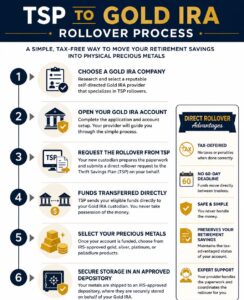
The rollover process is generally straightforward when working with experienced professionals.
Step 1: Research Gold IRA Companies
Compare providers based on:
- Reputation
- Customer service
- Educational resources
- Fee transparency
- Precious metals selection
- Buyback policies
- Storage partners
Step 2: Open a Self-Directed Gold IRA
Complete the application and establish your account with an approved custodian.
Step 3: Request the Rollover
Submit the required paperwork authorizing the transfer of eligible TSP assets.
Many custodians assist clients with this process.
Step 4: Funds Transfer
Your retirement funds are transferred to your new IRA.
Direct rollovers generally provide the smoothest experience.
Step 5: Select Precious Metals
Once your account is funded, you’ll choose from IRS-approved gold, silver, platinum, or palladium products.
Many investors work with specialists to determine an allocation that aligns with their objectives and risk tolerance.
Step 6: Secure Storage
The purchased metals are shipped directly to an approved depository where they are stored on behalf of your IRA.
How Long Does a TSP to Gold IRA Rollover Take?
Although timelines vary depending on processing times and documentation, many direct rollovers are completed within two to four weeks.
Factors that may affect the timeline include:
- TSP processing times
- Custodian paperwork
- Identity verification
- Funding method
- Metal availability
- Shipping to the depository
Starting the paperwork promptly and responding quickly to requests for documentation can help avoid unnecessary delays.
Costs and Fees
Understanding the costs associated with a Gold IRA can help you compare providers more effectively.
Common fees include:
| Fee Type | Description |
|---|---|
| Account setup fee | One-time charge to establish the IRA |
| Annual custodian fee | Ongoing administrative fee |
| Storage fee | Cost of storing metals in an approved depository |
| Insurance fee | Protection of stored assets (often included with storage) |
| Dealer markup | Difference between wholesale and retail pricing of precious metals |
Some companies periodically offer promotions that may reduce or waive certain fees for qualifying accounts. Be sure to review the full fee schedule rather than relying solely on promotional offers.
Tax Consequences
When completed properly, an eligible direct rollover from a Traditional TSP to a Traditional Gold IRA is generally not a taxable event.
However, taxes or penalties may apply if:
- You fail to satisfy IRS rollover requirements.
- An indirect rollover is not completed within the applicable deadline.
- You take a distribution that does not qualify for rollover treatment.
Because tax situations vary, consider consulting a qualified tax advisor before making decisions about your retirement accounts.
Ready to Learn More?
Thousands of retirement savers begin by educating themselves before making any investment decisions. Request a FREE Gold IRA Guide to understand rollover rules, compare providers, explore eligible precious metals, and evaluate whether a Gold IRA fits your retirement goals.
TSP Funds That Cannot Be Rolled Over
Although many TSP distributions are eligible for rollover treatment, not every withdrawal qualifies. Understanding which funds can and cannot be rolled over can help you avoid unexpected taxes or penalties.
Generally, the following distributions are not eligible for rollover into a Gold IRA:
- Required Minimum Distributions (RMDs)
- Certain periodic payments that meet IRS exclusion rules
- Hardship withdrawals
- Corrective distributions
- Some distributions specifically identified by the IRS as ineligible for rollover
If you’re unsure whether your planned TSP distribution qualifies, verify your eligibility with the TSP before initiating a rollover.
Pro Tip: Before requesting any distribution, confirm with your chosen Gold IRA custodian that it qualifies for rollover treatment. This simple step can help prevent costly mistakes.
Should You Roll Over All or Only Part of Your TSP?
One of the biggest questions retirees ask isn’t whether they can move their TSP into a Gold IRA—it’s how much they should transfer.
There isn’t a one-size-fits-all answer.
The right allocation depends on factors such as:
- Your age
- Your retirement timeline
- Risk tolerance
- Overall investment portfolio
- Income needs during retirement
- Personal views on the economy and inflation
Option 1: Partial Rollover (Most Common)
Many investors choose to roll over only a portion of their TSP while leaving the remainder invested in the plan.
Potential advantages include:
- Continued exposure to stock and bond markets
- Diversification across multiple asset classes
- Access to the TSP’s low-cost investment options
- Ownership of physical precious metals within a tax-advantaged IRA
A partial rollover can be an effective way to diversify while maintaining exposure to traditional investments.
Option 2: Full Rollover
Some retirees decide to transfer their entire eligible TSP balance into a self-directed IRA.
Reasons may include:
- Greater investment flexibility
- Consolidating retirement accounts
- Access to a wider range of investment options
- Preference for self-directed investing
However, moving all retirement savings into a single asset class may reduce diversification. A balanced portfolio should reflect your long-term financial objectives and tolerance for risk.
Gold IRA vs. Keeping Your Money in the TSP
Understanding the differences between a TSP and a Gold IRA can help you determine which approach best aligns with your retirement goals.
| Feature | TSP | Gold IRA |
|---|---|---|
| Physical Gold Ownership | ❌ No | ✅ Yes |
| IRS Tax Advantages | ✅ Yes | ✅ Yes |
| Investment Choices | Limited | Broad (within IRS rules) |
| Government Securities | ✅ Yes | ❌ No |
| Stocks & Bonds | ✅ Yes | Through separate investments only |
| Precious Metals | Indirect exposure only | Physical IRS-approved metals |
| Storage Fees | None | Typically Yes |
| Custodian Fees | Low | Varies |
| Inflation Diversification | Limited | Potential diversification through physical metals |
| Self-Directed Investing | No | Yes |
Which Is Better?
Neither account is inherently “better.” They serve different purposes.
The TSP is known for its simplicity and low costs, while a self-directed Gold IRA provides access to physical precious metals and a wider range of investment options.
Many retirees choose to use both rather than viewing them as competing choices.
Ready to Explore Your Options?
Before making any retirement decisions, request a FREE Gold IRA Guide. It explains how rollovers work, outlines IRS rules, compares leading Gold IRA companies, and helps you determine whether a Gold IRA aligns with your retirement goals.
How to Choose the Best Gold IRA Company
Selecting the right Gold IRA company can make a significant difference in your overall experience.
Because you’ll be entrusting a portion of your retirement savings to this provider, it’s worth taking the time to compare your options carefully.
1. Industry Experience
Look for companies with a strong track record of helping investors complete precious metals IRA rollovers.
Companies with years of experience often have established processes and dedicated rollover specialists who can help coordinate the transfer.
2. Transparent Fees
Avoid providers that are vague about pricing.
Request a complete fee schedule that outlines:
- Account setup fees
- Annual maintenance fees
- Storage fees
- Insurance costs
- Precious metals pricing
- Any commissions or administrative charges
Transparency helps you compare providers more accurately.
3. Educational Resources
Reputable companies typically focus on educating investors rather than pressuring them into making immediate decisions.
Look for providers that offer:
- Free investor guides
- Educational videos
- Webinars
- Retirement planning resources
- One-on-one consultations
An educational approach can help you make a more informed decision.
4. Customer Reviews and Reputation
Research independent customer feedback from reputable review platforms.
Consider factors such as:
- Overall customer satisfaction
- Responsiveness
- Transparency
- Problem resolution
- Longevity in the industry
Keep in mind that no company receives positive reviews from every customer, so it’s helpful to evaluate patterns rather than isolated comments.
5. Buyback Program
Ask whether the company offers a precious metals buyback program.
While you may not need to sell your metals for many years, understanding the buyback process in advance can provide additional confidence.
Questions to ask include:
- How are prices determined?
- Is there a guaranteed buyback policy?
- How quickly are transactions completed?
- Are there additional selling fees?
6. Storage Partners
Your Gold IRA metals must generally be stored in an IRS-approved depository.
Ask where the metals will be stored and whether you have options for:
- Segregated storage
- Non-segregated (commingled) storage
- Insurance coverage
- Independent audits
Questions to Ask Before Opening a Gold IRA
Before choosing a company, consider asking:
- How long have you specialized in Gold IRAs?
- What fees will I pay each year?
- Which depositories do you use?
- What educational materials do you provide?
- Do you assist with TSP rollovers?
- What metals do you recommend, and why?
- Is there a minimum investment requirement?
- What is your buyback process?
A company that welcomes questions and provides clear answers is often easier to work with than one that relies on high-pressure sales tactics.
Common TSP to Gold IRA Mistakes to Avoid
Even experienced investors can make costly mistakes during a rollover.
Here are some of the most common pitfalls—and how to avoid them.
Mistake #1: Choosing an Indirect Rollover Without Understanding the Rules
Indirect rollovers involve strict IRS requirements and may result in taxes or penalties if handled incorrectly.
Whenever possible, many investors choose a direct rollover because it is generally simpler and reduces the risk of administrative errors.
Mistake #2: Buying Non-Eligible Precious Metals
Not every gold coin or bar qualifies for a Gold IRA.
Always confirm eligibility with your custodian before making a purchase.
Mistake #3: Attempting Home Storage
Some advertisements suggest that investors can store IRA-owned gold at home.
In most cases, IRS rules require Gold IRA assets to be held by an approved custodian in an authorized depository. Improper storage could jeopardize the account’s tax-advantaged status.
Mistake #4: Ignoring Fees
Lower fees can improve long-term investment efficiency.
Compare providers carefully and understand all costs before opening an account.
Mistake #5: Making Emotional Decisions
Investment decisions should be based on a long-term retirement strategy rather than short-term market headlines.
Whether markets are rising or falling, maintaining a disciplined investment approach is generally more effective than reacting emotionally to daily news.
Frequently Asked Questions
Can I roll my TSP into a Gold IRA while still employed?
It depends. Some active federal employees may qualify for certain in-service withdrawals, while others must wait until they separate from service. Review current TSP rules or consult a qualified professional.
Is a TSP to Gold IRA rollover taxable?
When completed properly as an eligible rollover, it is generally not taxable. Tax consequences may arise if IRS rollover rules are not followed.
Can I keep my gold at home?
Generally, no. Gold held within an IRA is typically required to remain in an IRS-approved depository.
How long does the rollover take?
Many direct rollovers are completed within approximately two to four weeks, though timelines vary depending on processing times and documentation.
Can I own silver in a Gold IRA?
Yes. Many self-directed precious metals IRAs allow eligible investments in IRS-approved gold, silver, platinum, and palladium.
What happens if gold prices fall?
Like any investment, gold prices can rise or fall. Investors should understand the risks and consider how precious metals fit within a diversified retirement strategy.
Is there a minimum amount required?
Minimum investment requirements vary by Gold IRA company. Ask prospective providers about their account minimums before opening an IRA.
Can I roll over only part of my TSP?
Yes. Many investors choose a partial rollover, allowing them to maintain investments within the TSP while diversifying with precious metals.
Final Thoughts
A TSP to Gold IRA rollover can provide eligible federal employees and retirees with access to physical precious metals within a tax-advantaged retirement account. For investors seeking greater diversification, broader investment flexibility, or exposure to assets outside traditional stocks and bonds, a self-directed Gold IRA may be worth considering.
However, it’s important to remember that Gold IRAs are not a one-size-fits-all solution. Precious metals can fluctuate in value, involve ongoing storage and custodial fees, and should be considered as part of a broader retirement strategy rather than a guaranteed safeguard against market risks.
Before initiating a rollover, take time to understand the IRS rules, compare custodians, review fee structures, and determine how a Gold IRA fits with your financial goals, risk tolerance, and retirement timeline. Consulting a qualified financial or tax professional can also help you make an informed decision based on your individual circumstances.
Get Your FREE Gold IRA Guide
If you’re considering moving some or all of your eligible TSP funds into a Gold IRA, education should come first.
Our FREE Gold IRA Guide explains:
- How TSP to Gold IRA rollovers work
- IRS rules and common mistakes to avoid
- Eligible gold and silver products
- What to look for in a Gold IRA company
- Questions to ask before opening an account
- Strategies for evaluating whether a Gold IRA fits your retirement plan
Request your FREE Gold IRA Guide today and take the next step toward making an informed retirement decision.