
When the cost of living climbs and traditional markets turn volatile, many U.S. investors look for ways to safeguard their hard-earned retirement savings. If you are researching retirement accounts, you have likely weighed Precious Metals vs Inflation to understand whether physical assets can genuinely preserve your purchasing power.
The short answer is yes: historically, precious metals like gold and silver have served as reliable stores of value during periods of high inflation. Unlike fiat currency, which central banks can print in unlimited quantities, physical precious metals have a finite supply. For retirement savers, integrating these assets into a tax-advantaged vehicle like a Gold Individual Retirement Account (IRA) offers a strategic way to hedge against economic uncertainty without sacrificing tax benefits.
Understanding the Economic Threat: Why Inflation Erode Savings
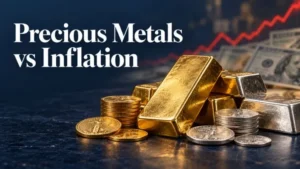
Before looking at how metals perform, it helps to understand what inflation does to a standard retirement portfolio. When inflation rises, the purchasing power of the U.S. dollar declines. A dollar today buys less than it did a decade ago, meaning cash holdings and fixed-income assets lose real value over time.
- The Cash Trap: Keeping too much cash in low-yield savings accounts guarantees a negative real return when inflation outpaces interest rates.
- Stock Market Volatility: While equities often outpace inflation over the long run, high-inflation environments can trigger corporate earnings contractions and severe stock market downturns.
- Fixed-Income Pressures: Bonds and certificates of deposit (CDs) pay fixed interest rates that can quickly become obsolete when consumer prices spike.
Precious Metals vs Inflation: How Gold and Silver Hold Their Ground
When comparing Precious Metals vs Inflation, historical data reveals a compelling pattern. Gold and silver have consistently maintained their intrinsic value across centuries, acting as a monetary safe haven when paper currencies falter.
1. The Historical Store of Value
Gold is widely recognized as a premier inflation hedge because its value is independent of any single government or corporate entity. When fiat currencies weaken, investors routinely flock to gold, driving up demand and price.
2. Supply Constraints vs. Fiat Expansion
Unlike government-issued money, new gold cannot be printed into existence. Mining new gold requires significant capital, time, and labor. This natural scarcity protects investors from the devaluing effects of monetary expansion.
3. Portfolio Diversification
Adding physical precious metals to an investment portfolio introduces an asset class that often moves independently of stocks and bonds. During inflationary spikes, this low correlation helps cushion overall portfolio volatility.
Protecting Your Retirement with a Gold IRA
For U.S. savers looking to transition a portion of their savings into physical assets, a Gold IRA is the most common vehicle. A Gold IRA is a self-directed individual retirement account that allows you to hold IRS-approved physical gold, silver, platinum, and palladium bars and coins while maintaining the same tax advantages as a traditional or Roth IRA.
Key Benefits of a Gold IRA:
- Tax-Deferred Growth: Traditional Gold IRAs allow your precious metals to grow tax-deferred until you begin taking distributions in retirement.
- Direct Ownership: You own physical, tangible assets stored securely in an IRS-approved depository rather than paper promises or exchange-traded funds (ETFs).
- Control and Flexibility: You can fund a Gold IRA through a tax-free rollover or transfer from an existing traditional IRA, 401(k), 403(b), or eligible retirement plan.
Want to learn more about setting up your account? Navigating the setup process is straightforward when you have the right information. Request your free Gold IRA guide today to explore step-by-step instructions, storage requirements, and rollover options tailored to your financial goals—all with zero pressure or obligation.
REQUEST YOUR FREE GOLD IRA GUIDE NOW ›
Common Questions About Precious Metals vs Inflation
Does gold always rise when inflation goes up?
While gold is a proven long-term hedge against inflation, its price can fluctuate in the short term due to interest rate changes, currency strength, and market sentiment. However, during sustained periods of high inflation, gold has historically preserved purchasing power better than cash.
What percentage of my portfolio should be in precious metals?
Financial advisors often suggest allocating between 5% to 15% of an investment portfolio to precious metals, depending on your risk tolerance, timeline, and overall financial strategy.
Can I store my Gold IRA metals at home?
No. IRS regulations stipulate that physical metals held within a retirement account must be stored in an approved, secure depository to maintain their tax-advantaged status. Attempting home storage can trigger severe tax penalties and disqualification of the IRA.
Take the Next Step Toward Financial Security
Understanding the dynamics of Precious Metals vs Inflation is the first step toward building a more resilient retirement strategy. Whether you are nearing retirement age or decades away, protecting your portfolio against economic instability is a critical priority.
If you are ready to take control of your financial future and want a clear, comprehensive breakdown of how physical assets fit into your retirement plan, we invite you to take the next step.
Claim Your Free Gold IRA Guide Today Discover everything you need to know about qualifying accounts, IRS-approved metals, secure storage, and tax-free rollovers. Empower yourself with the facts and make an informed decision for your future—completely at your own pace.